For crypto investors and their accountants

The crypto your tax software gave up on.

Koinly and Crypto Tax Calculator handle the easy 90%. The last 10% — dead exchanges, missing cost base, DeFi, bridges, theft losses — is left to you, and it is the part that actually decides your number.

I reconcile it by hand and give your accountant a pack they can file from.

Australian rules modelled in depth. Reconciled workpapers anywhere else — see where I work.

Why the software stops

Crypto tax tools are import-and-match engines. When an exchange no longer exists, when a CSV was never exported, when a position moved across three chains and a bridge — there is nothing to match against. The tool flags it and hands it back to you.

That is not a bug in the software. It is the boundary of what software can do without judgement. Both Koinly and Crypto Tax Calculator, including their done-for-you tiers, have been run against client positions in this work. Neither closes this gap.

What I actually reconcile

Dead and delisted exchanges

FTX, Celsius, Mt. Gox, QuadrigaCX, Cryptopia, ACX. No API, no export, sometimes no records at all — reconstructed from what does still exist.

Missing 2017–2018 cost base

The single most common blocker. If you cannot prove what you paid, no tax authority’s default assumption is in your favour.

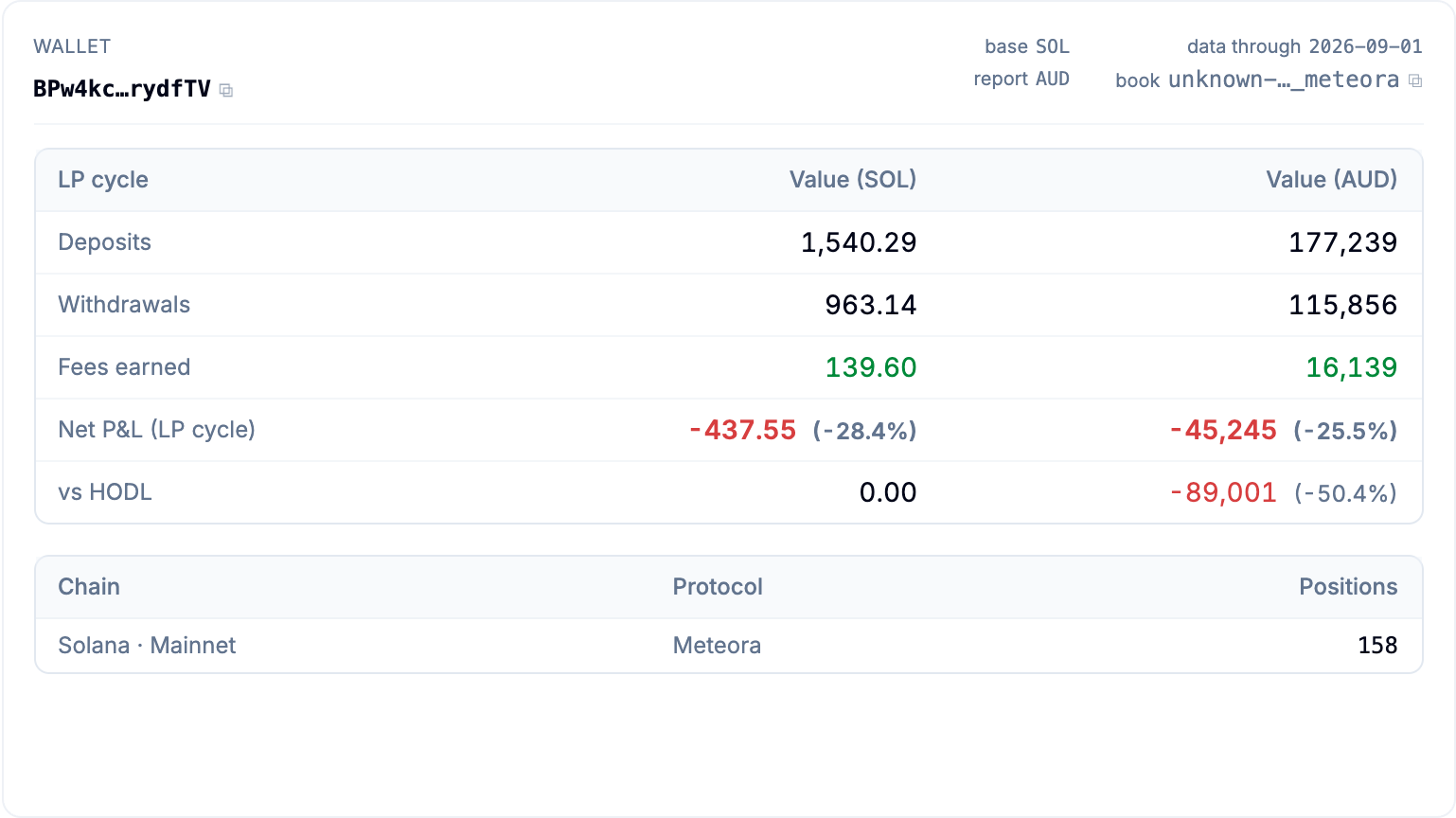
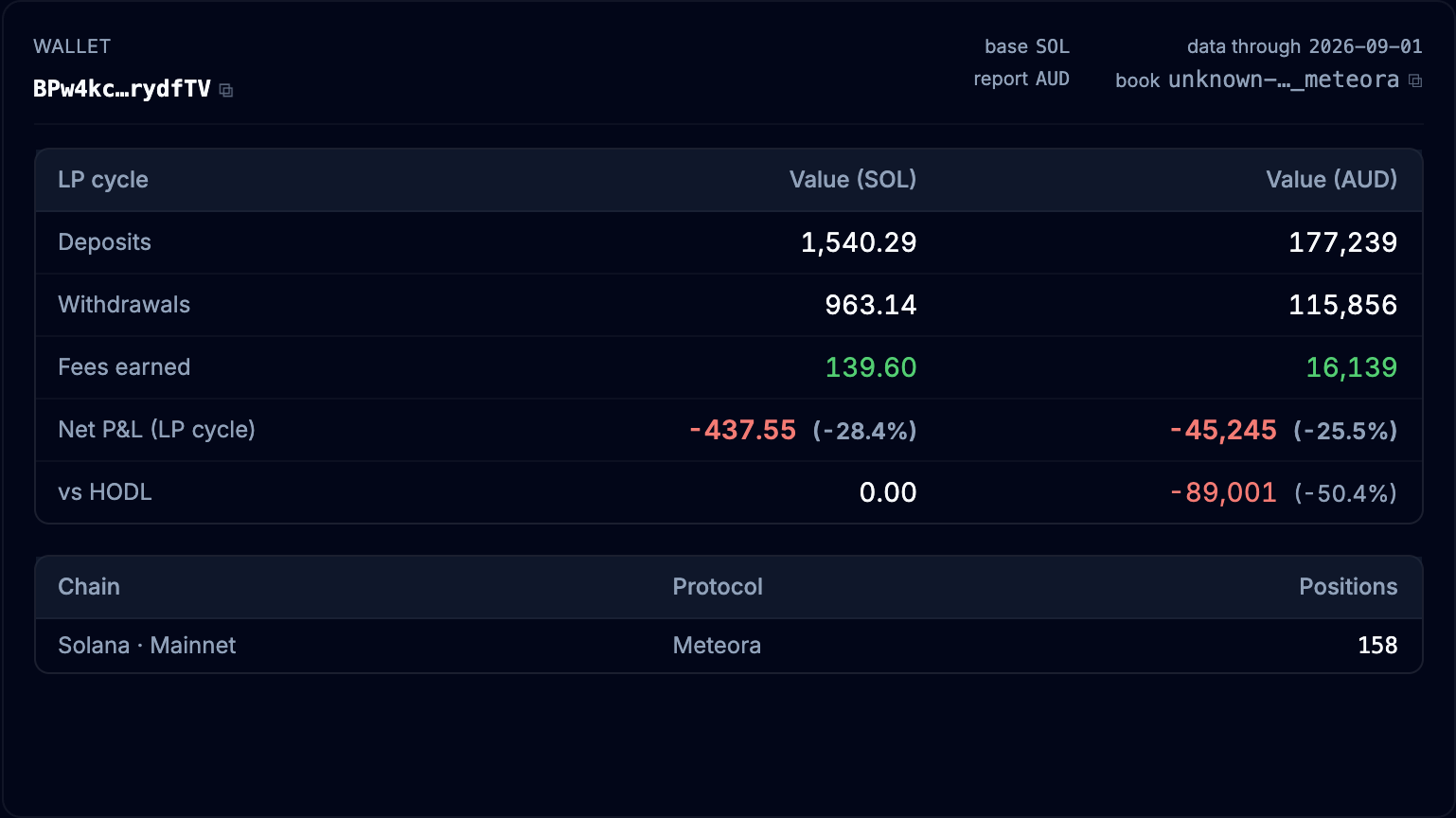
DeFi, LP positions and staking

Liquidity in and out, reward accrual, impermanent loss. Software either ignores these or guesses badly.

Bridges and cross-chain hops

The same asset across chains reads as a disposal and an acquisition unless someone traces it properly.

Lost keys, hacks and scam losses

Whether a capital loss is available, and what evidence substantiates it. Documented, not asserted.

Airdrops and forks

Acquired at what value, on what date, and is it income or capital. Usually mis-handled by default.

What you get

  • A reconciled capital-gains pack — every disposal, its cost base, the gain or loss, and the reasoning where a judgement call was made.
  • Citations, not assertions. Each number traces back to a transaction, a statement, or a documented assumption your accountant can review and stand behind.
  • An honest list of what could not be resolved, and what that means for your return. Some things genuinely cannot be reconstructed — you will be told which.

Where this stops

I produce reconciled workpapers. Your own accountant or registered tax agent reviews and files them. This is not tax advice, not return preparation, and not a filing service, in any jurisdiction — and I will not take custody of your assets or ask you to connect a wallet or sign anything.

How it works

  1. 1

    A few messages to establish scope

    What you hold, which years are open, and where the records stop. You get a price scaled to transaction volume and how much of it needs hand work — or an honest "I can’t help with this".

  2. 2

    You send what you have

    Exchange exports, wallet addresses (public, read-only), bank statements. Whatever exists — the gaps are the job.

  3. 3

    I reconcile

    The automated pipeline handles volume; I handle the tail by hand. Where a judgement is required, it is recorded with its reasoning.

  4. 4

    You get the pack

    A reviewed capital-gains pack, ready for your accountant. Questions answered until they are satisfied.

Where I work

The reconstruction is the same everywhere — a disposal is a disposal, and a missing cost base is missing in every language. What changes is the tax treatment applied on top, and that is your accountant’s call in every case.

Australia

Rules modelled

CGT with the 12-month discount applied per parcel, Australian financial years, ATO evidentiary expectations on cost base. Self-lodgers are due 31 October; through a registered agent you generally have longer.

United States

Workpapers

Short- and long-term disposals separated by holding period on a calendar year, ready for your CPA to take to Form 8949 and Schedule D.

United Kingdom

Workpapers

Disposals and acquisitions dated and evidenced for your accountant to run HMRC’s pooling and 30-day rules over.

Canada

Workpapers

Dispositions with proceeds and cost, ready for adjusted-cost-base treatment and the capital-versus-business-income call your accountant makes.

New Zealand

Workpapers

Full acquisition and disposal history with purpose evidence, for your accountant to assess against the intention test.

Anywhere else

Workpapers

The reconstruction does not change. You get every disposal, its cost base and its evidence in a neutral format your local accountant applies their own rules to.

Rules modelled means the engine applies that country’s capital-gains rules directly. Workpapers means you get the reconciled underlying history — every disposal, cost base and piece of evidence — and your local accountant applies the rules. Either way I do not file, and either way the numbers are traceable.

Your records stay on my machine

Reconciliation runs locally on hardware I control. Your exchange exports, bank statements and full transaction history are not uploaded to a cloud service and are not used to train anything. Read-only wallet addresses only — never keys, never seed phrases, never a wallet connection.

This is for you if

  • You have years of activity and no clean cost base
  • You held on an exchange that collapsed
  • Your accountant has asked for numbers you cannot produce
  • You have DeFi, LP or cross-chain activity
  • You have unclaimed losses from theft or a rug

It is not for you if

  • You bought BTC on one exchange and still hold it
  • Koinly already gives you a number you trust
  • You want someone to prepare or file your return
  • You are hoping to recover stolen funds — I document losses, I do not chase them

Find out if it can be reconstructed.

Send me a message describing what you hold and where the records stop. You will get a straight answer either way.

AccountMD